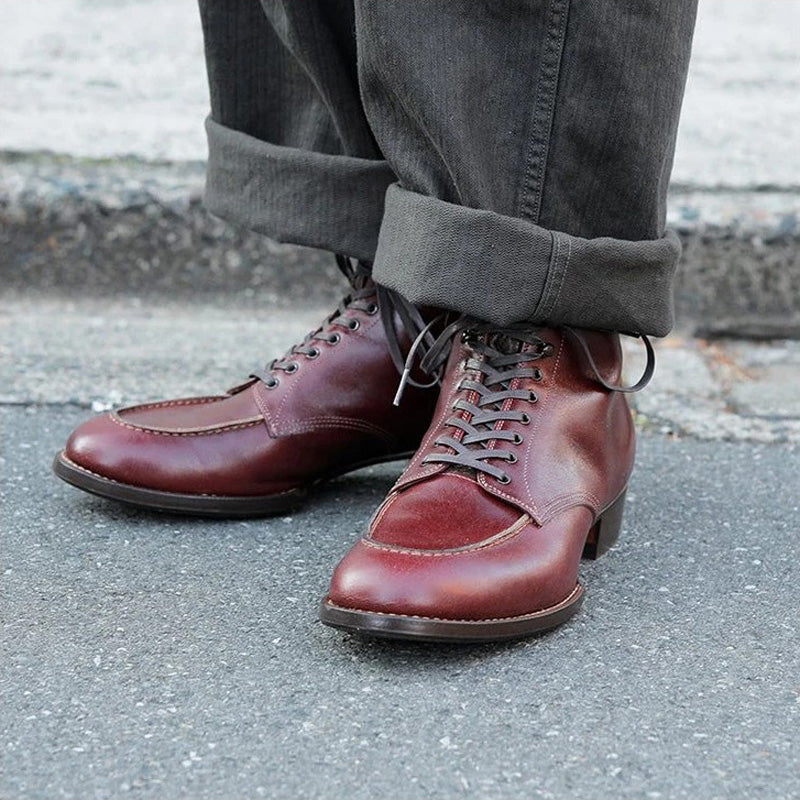
The 2 Monkeys(JELADO the BOOTED) "TM94903" Sportif Horse Hide Crimson
The 2 Monkeys(JELADO the BOOTED) "TM94903" Sportif Horse Hide Crimson
[The 2 Monkeys(JELADO the BOOTED) "TM94903" Sportif Horse Hide Crimson]
The 2 Monkeys “SPORTIF” is a new type of moccasin-toe boot that recreates the elegant, curvaceous silhouette of early 20th-century footwear. It offers an exceptional fit—with soft leather that envelops the foot—and a lightweight, agile feel that sets it apart from conventional work boots.
The design fuses the stylistic elements characteristic of European boots from that era with the moccasin-style toe—a design that gained popularity in America during the same period.
The leather used is "horse front" (hide from the front of the horse), vegetable-tanned in Tuscany, Italy. Selected for its substantial thickness, the leather is base-dyed before undergoing a secondary "surface-dyeing" process in Japan, resulting in a "tea-core" (brown-core) finish.
Because the leather is base-dyed in a deep brown, the tea-core effect—revealed as the surface wears—appears refined and subtle.
The leather is light and supple, conforming to the foot from the very first wear and providing a snug, all-encompassing fit.
The aesthetic of the era is particularly evident in the construction of the sole.
By employing a Goodyear-welted construction for the forefoot and a Blake-stitched construction for the waist and heel, the design achieves a sharply tapered, beveled "spade sole" silhouette.
The inclusion of a pitched (inward-tapering) heel is another detail frequently seen in footwear from that period.
The heel profile follows an S-curve; the supple leather faithfully captures the contours of the last, while the pitch of the compact heel further accentuates this graceful curve.
With curves integrated throughout the design—from front to back and side to side—the boot embodies an elegant style rooted in traditional European aesthetics.
A thin, pliable leather toe stiffener is incorporated into the toe box.
As the boots are worn in, the toe box will gradually flatten, allowing the leather to conform perfectly to the shape of the toes.
A 3mm-thick rubber sheet is applied to the forefoot section of the sole. The heel top-lift is made of 10mm rubber. This rubber contact surface provides a firm grip on the ground, prevents slipping, and reduces wear on the sole.
The wearing experience is remarkably light and supple—a result of the leather’s inherent qualities, a unique construction method, and a highly flexible single leather sole. Those accustomed to wearing work boots will likely be surprised by the lightness and the immediate, natural fit the moment they slip them on.
The "Sportif" last—roughly equivalent to an "E" width—is designed for a slightly relaxed fit on a standard foot shape; however, those with narrower feet can still achieve a secure fit by tightening the laces, thanks to the suppleness of the leather. For those with high insteps or wider feet, choosing a slightly larger size relative to the foot length will not significantly compromise the fit. This is because the sole is tapered at the arch, allowing the foot to rest comfortably upon the soft leather.
Beyond their elegant style and the pleasure of watching them age, these boots incorporate the very best qualities of footwear from the 1920s and 1930s—specifically in terms of comfort.
Between the late 19th and early 20th centuries, many European shoemakers traveled to the United States to study mass-production systems. This era saw a cross-pollination of ideas between Europe—with its deep-rooted traditions—and the United States, which had rapidly developed mass-production capabilities to accommodate a population boom driven by immigration and economic growth.
"Sportif," a boot by The 2 Monkeys, draws inspiration from the boot designs shared by both Europe and America during that period. It is a truly exceptional boot, equally well-suited to American-style and European-style aesthetics.
[Footnote]
(*) Moccasin-style toe: There is a historical connection between the moccasin and France. In the late 18th century, shortly after the United States gained its independence, what is now the American Midwest was under French control. This vast inland territory stretched from Minnesota in the north to Louisiana in the south, and as far west as Montana, Wyoming, and Colorado.
A significant number of French people were active in this region, engaged in fur trapping, trade, and missionary work.
At the time, however, this was an untamed wilderness; venturing into it would have been impossible without the cooperation of the indigenous peoples (Native Americans). The French lived alongside these indigenous groups—trading goods and interacting with them—and it is said that they eventually swapped the shoes they had brought from France for Native American-style moccasins.
In fact, the French may well have been the group among white settlers who wore moccasins most frequently.
Perhaps due to this history, even today, some of France’s most prominent leather-shoe manufacturers feature a "moccasin-stitched" toe on their signature models. There is a clear affinity between France and the design of moccasin-style footwear.
(**) "Beveled waist": This refers to a technique used in Goodyear-welted construction where the outer stitching along the waist of the sole is concealed by a strip of leather (part of the welt). This is done to accentuate the tapering—or "narrowing"—of the shoe's waist.
While still occasionally used in bespoke shoemaking today, the "beveled waist" look is achieved here by employing Blake (McKay) construction for the rear half of the shoe.
(***) "Pitched heel": A heel design that tapers linearly from the sole toward the ground-contact surface. This is a detail frequently seen in European footwear from that era.
(****) The comfort qualities of leather shoes from the 1920s and 1930s: During the 1920s and 1930s, there was an abundance of footwear crafted from soft leathers, such as kangaroo and kidskin (goat leather). As sneakers became more widespread over time, leather footwear increasingly specialized—either toward the formal aesthetic required for business, or the rugged durability demanded for work and outdoor activities. In the process, the softer, more supple types of leather shoes largely faded away.
"Sportif" recaptures the comfortable, easy-wearing feel of those classic, soft leather shoes, allowing you to experience a quality that has been largely lost to time.
Key Details of "Sportif"
The boot features a lightweight, flexible single leather sole. The rounded edge (welt/trim) at the waist accentuates the contrast with the forefoot, while the slightly pitched heel evokes the style of the early 20th century.
The combination of this sole, premium calf leather, and the specific construction method results in a remarkably lightweight boot.
The sharply tapered waist evokes the distinct atmosphere of that bygone era.
Constructed using a Blake (McKay) stitch to attach the upper to the single leather sole, the boot offers a soft, gentle fit, particularly through the arch.
While American moccasin-style boots from the 1920s and 30s typically featured "decorative" moccasin stitching on a round-toe vamp, "Sportif" utilizes a true moccasin construction, joining the side and upper leather panels together.
The toe box, reinforced with a thin leather stiffener, will gradually conform to your feet and settle in as you wear them.
*NOTE*
This item cannot be exchanged or returned. Please carefully check the size before ordering.
The official price (110,000 yen) will be the price listed on the shipping slip upon shipment.
Price changes and gift delivery are not available.
In addition, this item is made using materials that make the most of the natural texture of the leather.
As a result, the item may have uneven color, varying grain, scratches, stains, or wrinkles.
Please understand that these are inherent characteristics of leather.
Even if the above conditions are present, this item is still authentic and cannot be exchanged or returned.
※ITEM DATE※
• Item number: TM94903
• Horsehide (Italian-made, vegetable-tanned, dyed in Japan)
• Goodyear welt construction (forefoot) + McKay construction (waist to heel) Leather (with half-rubber sole)
• Made in Japan
*Kikuchi's Sizing*
When I wear these Sportif Horse Hide, I wear a US 8.5.
My regular shoes are White's Semi-Dress and Smoke Jumper, and I wear a US 8.
I wear a UK 8 for Paraboot Chambords.
I used to wear a US 8.5 for Red Wing Beckmans.
I used a US 8.5 for Nike Air Force 1s.
Fit may vary depending on the height of your instep, so please use this information as a reference only.
*Product photos were taken with a digital camera. Please note that the color may appear slightly different from the actual product due to the monitor settings.
Share